Pi Is Baptized and Gets a Prayer Rug
Life of PiPi Patel’s baptism and acquisition of a prayer rug make his religious commitment tangible: rather than surrender one form of devotion for another, he asks to enter Christianity while retaining his wish to pray to Allah. The episode turns a conflict over religious categories into a pair of practices—a baptism and a carpet laid outdoors—and establishes a pattern in which belief is lived through the body, ordinary objects, and repeated ritual.
Background in Religious Practice
Pi Patel’s request grows from an early religious life shaped by more than one tradition. As a baby in Madurai, he was taken to a Hindu temple by a maternal aunt. He later explained that he had no conscious memory of the visit, yet imagined that its light, incense, music, and ritual might have planted an early seed of religious feeling. His attachment to Hinduism was bound to these sensory forms as well as to its account of the universe: worship was not merely an idea but a place, a gesture, and an encounter with what he experienced as sacred.
His interest in Islam also developed through observed practice. While visiting a baker, Pi Patel watched him interrupt an explanation of bread-making, unfurl a carpet in the flour-dusted bakery, and pray through a sequence of standing, bowing, and prostration. The prayer struck him as physical and direct. Later, at a mosque, he listened to the imam and watched worshippers arrange themselves shoulder to shoulder before prayer. Bringing his forehead to the ground felt to him like a deeply religious contact. The baker’s account of Islam as devotion to the Beloved, and the Sufi hope of union with God, made the faith personal as well as communal.
These encounters help explain why Pi Patel’s request does not feel to him like a switch from one identity to another. His devotional life had already taken shape through distinct practices that could each bring him close to God. The prayer rug and baptism would give those commitments material and formal expression, not resolve them by making one disappear.
The Request and Its Challenge
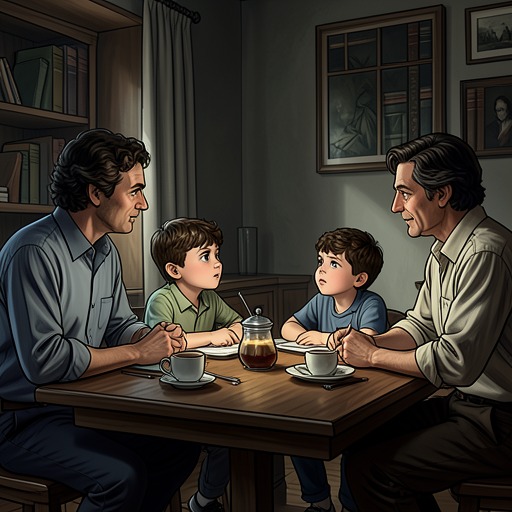
A few days after the religious dispute on the esplanade, Pi Patel went to see Father Martin. He asked to be baptized and to have a prayer rug. The two requests had practical and religious dimensions: he wanted to pray outside without getting his trousers dirty, and he believed that attending a Christian school without baptism left his Christian commitment incomplete. When Father Martin asked why he wanted to pray at all, Pi Patel answered that he loved God.
Father Martin was taken aback, then tried to make the request seem unnecessary. Petit Seminaire, he explained, was Christian only in name; Hindu boys attended without being baptized, and praying to Allah would not affect Pi Patel’s education. Pi Patel nevertheless insisted that he wanted to pray to Allah and to become a Christian. Father Martin responded that he could not be both and had to be one or the other. Pi Patel’s question—why the two forms of devotion could not coexist—states the episode’s central conflict more plainly than any theological argument could.
Pi Patel brought the same request to Pi’s mother. She said he should speak to his father, then told him that his parents found his religious zeal difficult to understand. She, too, invoked the demand to choose among Hinduism, Christianity, and Islam. Pi Patel answered by comparing religious plurality to his maternal uncle’s possession of Indian and French passports: one identity need not cancel another. The comparison gives his position a familiar, everyday scale. He does not present multiplicity as an abstract doctrine; he treats it as a livable condition.
Baptism and the Prayer Rug
The prayer rug gave his devotion a portable place. Though ordinary in quality, it seemed beautiful to Pi Patel. Its red ground carried gold lines, and its narrow rectangular shape ended in a triangular point indicating the direction of prayer. Small curlicues softened the pattern; the pile was soft, and its short tassels marked a compact space for his forehead and feet. He valued it not simply as equipment but because it made a patch of ground feel specially loved while reminding him that the earth was sacred everywhere.
He most often spread it in a secluded corner of the yard, behind the house, in the shade of a coral tree. A wall threaded with bougainvillea and lined with potted poinsettias bounded the spot; beyond the mottled shade lay the sunlit yard. Pi Patel faced Mecca by using a line scratched into the pale yellow ground and carefully maintained. The line converted direction into a small domestic routine, while the rug made prayer possible in a familiar outdoor setting. His father, mother, and Ravi Patel sometimes watched him finish praying; in time, the family grew accustomed to seeing him there.
The baptism followed, awkwardly but decisively. Pi’s mother played along, Pi’s father watched stonily, and Ravi Patel was absent because of a cricket match, though his absence did not stop him commenting at length afterward. The water came from a beaker and ran over Pi Patel’s face and neck. He remembered its small quantity as refreshing, like rain in the monsoon. The scene does not erase the family’s uncertainty; it records the rite taking place within it.
Continuity and Significance
The episode’s objects and gestures anticipate how Pi Patel will sustain faith under radically altered conditions. During his ordeal at sea, he adapts familiar practices: solitary Masses without priests or consecrated hosts, Hindu worship without images, offerings using turtle meat, and acts of devotion to Allah despite uncertainty about Mecca and mistakes in Arabic. Those later adaptations echo the childhood scene’s insistence that devotion can survive outside its usual institutional setting. The rug is especially significant in this respect: Pi Patel remembers loving it and being sorry to lose it, but the account does not make possession of the object a condition of continued prayer.
At sea, when anger and exhaustion threaten to overwhelm him, he names the objects and surroundings of his confinement as parts of God’s creation. The exercise does not make hardship disappear: the boat remains a prison, Richard Parker a danger, and the ocean an immense threat. Yet the repeated act of looking for creation within those circumstances helps him recover a point of light and continue. The childhood request for a rug and baptism thus belongs to a larger pattern. For Pi Patel, religion is neither only an inherited label nor an argument about which faith is correct; it is a set of physical, repeatable ways to turn toward God, even when the place, the materials, and the conditions of prayer have changed.